
Home » Articles posted by helpingbrainz (Page 15)

Author Archives: helpingbrainz

News/Events@HB

Cleanliness Campaign

image

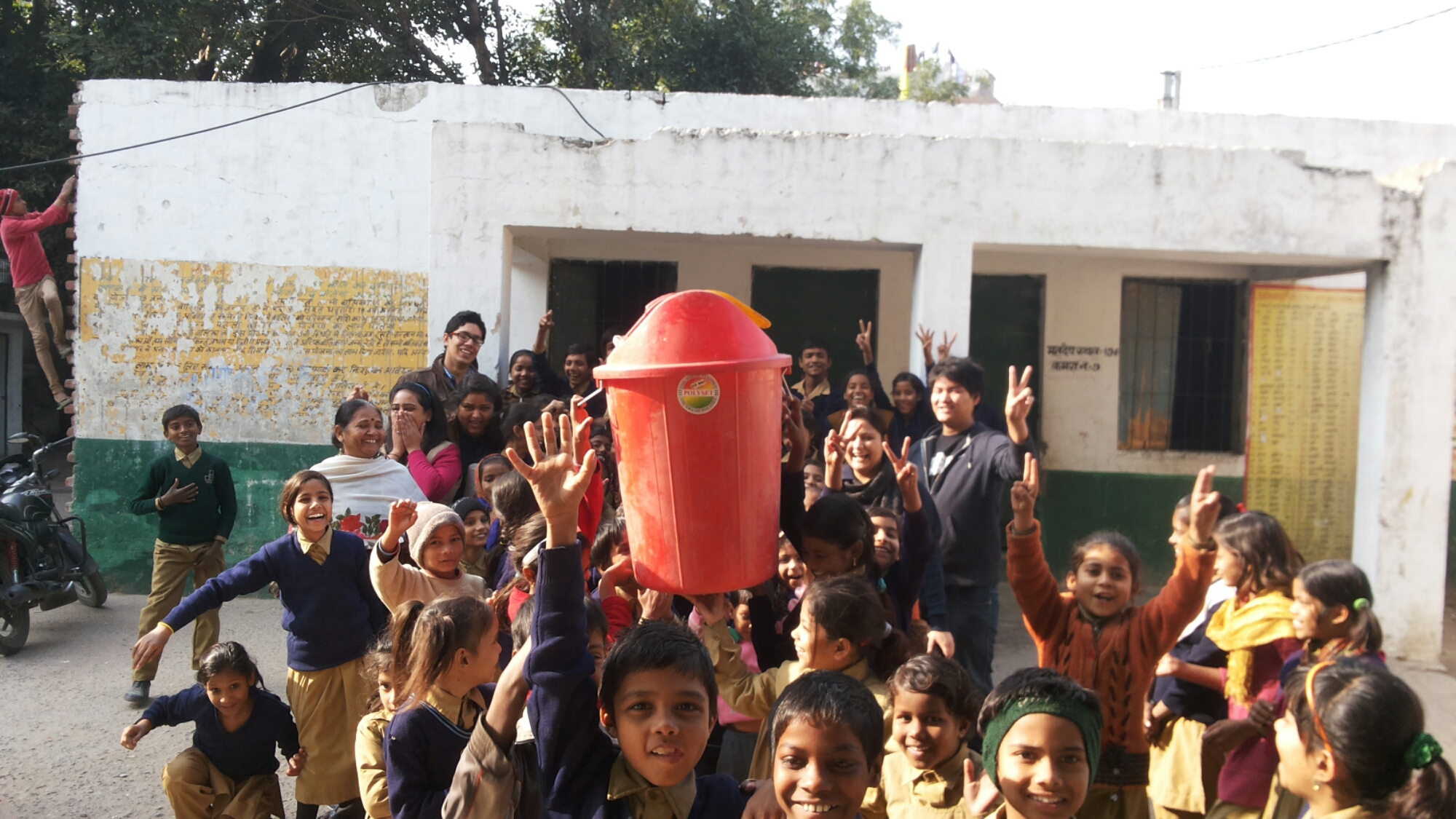
A view from the cleanliness campaign we did at Nithari’s Government School. Well this was a surprise for all, the campaign was not there in the event list designed by me and Mahima.

After completing the Paint Your Dreams event, I went to the children who were playing some muddy games 😉 “who all want their school to be the most cleanest”, haha they’re children – all hands raised.

We divided ourselves into teams (50+ children,  Me, Sunil Kumar  Gitanshu, Ajit, Swati, Pallab, Mahima and Himani) and made an agenda to pick up the maximum number of papers and polythene bags scattered around in the school.

In 5 mins we cleaned the school, classrooms and the ground. Impact and learning via games.

We don’t need a banner or brand name to be christened to make an impact,  every one can do it however do it for yourself however not for a selfie or for a celebrity.

By Yedhu

Posted from WordPress for Android

Ujjwal reaches to 4200+ kids !

Do you need to be an organisation to do social work ?
Do you need to certified as a social work to embark smile on the kids face ?
Well, for us (‪#‎helpingbrainz‬) these lines stands out of scope. We’re not an organization however we work in an organized manner by being a team of good friends with a good moving Facebook page (Facebook.com/helpingbrainz).

Yesterday [ 20/12/2014 ] we reached to 500+ underprivileged of Nithari, Noida and helped them in painting their dreams. Also distributed School Stationeries, Food and colours. The event was inaugurated by the Gram pradhan Shrimati.Vimlesh Sharmaji, preceded by a health check up camp by BHBteam (Apollo Hospitals)- an event coordinated Pallab Doley from AIESEC Delhi University, food donations by Priya Gupta Ma’am, and then it was all Helping Brainz and kids.

As usual Yedhukrishna Menon, conveyed the message of cleanliness and happy growing to the children, we together cleaned the schools snd played together.
After this event, our total outreach becomes 4200+ kids, more to go.

Thanks to all, I can’t make it limited to some, however there were 100s who contributed to their smiles. Thanks again – we can’t buy their happiness, can’t define, we can just give,we are just propelling what our parents and teachers taught us, we just do what we can and that’s what is required to develop a nation. We don’t define help and neither work to bear fruits.

Mentioning MadhusudhananMenon Ambika P Menon Anan Dhu Krishna Menon Vineeth Psethu Preeja Nair Himani ChauhAn Ram Kumar Douglas Leaf Racionzer Dr.Rathi Menon Avy Johar Ashim Borpuzari Aachal Sharma Sahil Bansal Robert Shepherd Sally-Ann Bethea-Holt Milena Parteli Yaja Vergara Bonilla Sophia Rishil Nilofer Khan Ainee TanwirAayushi Singh Mini Singh Abhilasha Chaudhary Purnoor Khan(the magician who converted my ideas into a poster/image) Gitanshu KhuranaMohit Sukhija Rajeev Thakur Neeraj Shukla Shanu Kollam Sanjoy AbhinavRupak Kashyap Ankur Khandelwal Somi Shukla Shubhendu MishraRehan Aziz Durgesh Patel Utsav Anand Sujata Kapoor Ushank SinghalAjit Mahapatra Pankaj Jha &
Mahima Sahney AND Swati Saini AND Maitreyee Dasgupta (the brave hearts who drew this event).
Special thanks to Vimlesh Sharma,Priya didi for sponsoring the one day meal, Pallab Doley from AIESEC DELHI University for arranging the health awareness camp, Amit Chitra for printing the posters, Shashank Tripathifor transporting the posters, Nitin Kumar and team for handling the event.
Thanks again,
Regards,
Yedhu – Founder,
Helping Brainz

Empowering Nithari Village!

Helping Brainz works for children, women,  old age, rural development,  international peace,  community development, health care and youth leadership programmes.

Helping Brainz would be helping Smt.Vimlesh Sharma Ma’am (Village-Head) in empowering the underdeveloped village of Nithari.

Helping Brainz had a brief meeting, question and answer session with the Village head of Nithari,  a visionary who’s only aim is to empower the village. In the first of the meeting she talked about the people,  the orthodox mentalities of the inhabitants, the need of infrastructure development and education.

Second half she spoke about the need of development and specific areas of development.

Helping Brainz tried analysing the situations and implementation areas, and we finalized the following,
We would be conducting,
– Rural Education Programmes-covered by our Child Empowerment cell and Rural Development cell,
– Rural Educational Counselling Programmes-covered by our Child Empowerment cell,
– Counselling for Children/ Women – Covered by the Women Cell at Helping Brainz
– Rural Recruitment Fair – Covered by Our Rural Development cell,
– Health Check up campaigns by our Health Care Awareness Team,
– Upgrading the educational status of the children and empowering the schools.

We’re going to pitch in on our duty from November 29th, 2014.
Interested folks please contact 9212840007 or mail us at help@helpingbrainz.org

Nithari is a village in the Noida, a tiny village in the outskirts of western Uttar Pradesh, India. Nithari in past was in news since it witnessed some unforgettable and unforgivable crimes against children and women.  Nithari is still living in the dark clouds and struggling hard to come out of the same.

For more images click on https://www.helpingbrainz.org/gallery/pyd-nithari/

Posted from WordPress for Android

Step-1 in empowering Nithari. Nithari we’re with you!

20141018-DSC_5674.jpg


Step-1 in empowering Nithari. Nithari we’re with you!


“Education is not the filling of a pail, but the lighting of a fire.”- W.B. Yeats

 Helping Brainz in it’s process to enlighten the world touched milestones by marking the 100th hour of weekend social work and covering 350+ students in one-go.

Helping Brainz on Saturday 18th October landed in the slum area of Nithari Village,  Noida Sec 31 – which is still in the phase of development and conducted

– Paint Your Dreams for 350+ Children in 2 batches

– Food donation drive

– Free health check up camp with the help of IndusGulf Hospitals

– Donated School Stationeries to All the 350+ children

The children were from rural backgrounds, with their parents being daily wage workers .

We requested the children to maintain their surroundings,  their school, their home and themselves clean. – this was the first message we delivered to the young crowd gathered.

I was motivated with the silence and humbleness they maintained to listen to our wordings, which surprised all the present teaching staff over there.

Hereafter, Helping Brainz would be working for the development of the children by facilitating more events, teaching programmes,  devising activity based learning programmes, training the teachers programmes.

My sincere thanks to

-all kids for patiently cooperating with all of us,

– Poonam Ma’am and the entire teaching staff for coordinating with us,

– Ravi Bhargav, Doctors and the team from IndusGulf Hospitals, -all the Helping Brainz Social Development Consultants (Ashim Sir,Preeja Nair, Mahima Sahney, Neeraj Shukla, Himani Chauhan, Abhilasha Chaudhary and Sujata Kapoor),

-The young dynamic event coordinator Ms.Abhilasha Chaudhary -Rajeev and Ali, for capturing the moments (Image Courtesy)

-Ajit Mahapatra, Vallabh Kollegal, Sonam Chopra, Renu Rawat, Nikhil and  Shailesh Singh for all their whole hearted Voluntarism,

-Abhinav Vikash & Nidhi Saxena(HCL) -Driver Fakru for transporting Us.

It’s  a start – we have more to do – together!


/* For images Click here */

The Art of Giving

Giving is workship

“The Art of Giving”

Children – teach – Children

Me and Avy, while drawing the sketchline of all the Helping Brainz activities at PH-Dwarka, thought of naming this event as the Paint Your Dreams -2 ( or PYD-2) , however after one year, after we complete a small discussion with Sonia Satyawan ( Manager- Operations , Aster Institutions ), we thought of re-conceptualizing this complete idea as “the Art of Giving”.  We, at Helping Brainz doesn’t feel that we need a definite age or degree to do social work, and every human being do have a special ability – a differentiating capability,  so taking Sonia Ma’ams words into granted, we thought why can’t we transform the entire developed and stabilized children-youths-and the general public into social work or into the “art of giving”.

–          We all waste food, now if we go to certain slum areas or some of the adjacent areas of new Delhi railway stations , or the slums of Yamuna Pushta – we would stop wasting food.

–          We buy dresses every weekend, however what about them who knock your car’s door , have you ever watched their dressing sense ?

Our modernized youth live in fantasies, however what if they also learn about the “art of giving” – we guess it would be a step stone towards development, development here we aim is nation development.

Art of Giving mainly aims in educating urban children to help their brothers and sisters from the rural/slums area thereby we can increase the brotherly hood among the children, remove the border-line of difference.

Indian_children_with_hearing_loss

How can we achieve this equilibrium ?

 ð  As a step-1 we wish to conduct, a Paint your dream painting competition, this competition would be having a small participation fee, also we would be gifting a packet of crayon to each child who participates in the event.

ð  The best ones would be

o   awarded,

o   uploaded onto the Abstract4life website,

o   converted into Greeting Cards and Calendars,

o   and would be sold off in malls and corporates ( same as PYD-1 ).

    • The money we would be generating would be used for the education of the rural children, and the educationists would be the urban children.

Through this process:

ð  We invent the Art of Giving

ð  Children teach Children

ð  Learning through Engagement

ð  Activity based learning

My sincere thanks to discussions by Sonia Ma’am , Panky , Preeja and Ashim Sir, which made me think on these lines – Yedhu Krishna Menon, Founder – Helping Brainz


#A Tear that trickled when Margaret sang for the peace in India, China and the World!

Abstract : Helping Brainz in association with AIESEC  Delhi University conducted “International Cultural Congress for Peace” at ASTER Public School, Noida.

How it happened : 8/13/2014 was a day of experiment in Yedhu Krishna Menon’s life. I’m a social worker, I help people in my own way, or in a way which was shown by my mother ,I’m just a facilitator.

Helping Brainz works for women, children, rural development, healthcare and now spreading “international peace”, a weekend mission by us from 2012.

When my senior friend and, our project leader for rural development projects – Ashim Sir called me and discussed about the collaboration of the interns for a nation development and international peace programme, I didn’t any clue. However, Prince and Ishita helped me to make it a ‘programme’, I never knew that this programme can create  new definitions in my life for humanity.

“I know not with what weapons World War III will be fought, but World War IV will be fought with sticks and stones.” – Sir Albert Einstein

When the world is fighting each other to prove their domain power, thereby ending peace and popularizing negativity everywhere, we Helping Brainz are bravely offending such powers to spread positivity. As a mission one we started with International Cultural Congress for Peace, with 14 soldiers of peace from 4 different countries ( India, China, Equador and Kazakhstan ) volunteered for a noble mission of spreading peace.

Helping Brainz orchestrated a 1.5 hours experience sharing congress where volunteers from 4 different countries shared their culture, education, traditions, cuisines, government and their beliefs, wherein the audience comprised of children (dressed in white) and teachers of ASTER Public School, Noida.

The event started with presentations by ( in sequence ) :-

  • Marshell on Chinese Education,
  • Margaret on Chineese Culture,
  • Doris and Peter on Paper Cuttings and Embrodiary Science of China,
  • Peter Green’s ( from China ) Tai Ji Presentation,
  • Introduction to Kazakshtan by Farisa,
  • A Visit to Equador by Yaja,
  • Galloen’s Chineese Class

Well, the event ended by a beautiful prayer by Margaret Wong, which really wet my eyes, music doesn’t have a language, however we understood the meaning of humanity and we all prayed for peace.

I’m overwhelmed by the co-operation showcased by the students, teachers and other staff members.


Founder’s Message

Hi!! Thanks for stopping by My friend,

We’re still a handshake away!

Im a Technology Analyst (auditing) , an entrepreneur , a social worker. I wish to discuss about a hobby which I have cultivated for the welfare of mankind. Being a technology analyst , I’m tightly packed on my weekdays , so on weekends I devote my time for the social development of beings from African, ASIAN ,SAARC and under developed nations.

Dear, my mission is to help you, our family,  our community and last but not the least our nation. This is a common man’s strategy to make a country developed. Now, when we talk about development as a nucleus of an atom (where I consider you as a reason for nation’s development), there are n number of protons and neutrons embedded in it and surrounded by good number of electrons. As neutrons are neutral,  the nucleus posses positive charge, however if we need to reach this positive nucleus,  we need to cross a big barrier of negatively charged electrons, now I consider these negative entities (corruption,  disrespect to women , harassment , drugs, terrorism,  ego, etc..) as the roadblocks for my country’s development.

Now the question is how we can overcome these menaces ? How can we stop a person from raping Nirbhayas and burning Anuhyas, as every hour a Nirbhaya is getting ruptured ( one way or the other). As a common , I approached the Government,  Organizations, Politicians,  change makers (the so called democracy makers) , however no one helped.

So, I started my independent research on the same on my weekends, I was accompanied by my mother’s blessing and family’s support , and started educating people about brotherhood,  love , humanity , patience and thereby making my audience teach their fellows,  thus the idea started enveloping a big mass of people,  whom I started calling a Helping Brain (a name coined by Avy Johar and Yedhu Krishna Menon), thereby people started calling us (our team) – Helping Brainz.

We started a phenomenon of respecting each other’s feelings and experience,  and I realized one fact, that, education is the only way to tackle down the social roadblocks. As a blessing , I found Sir Nelson Mandela saying these lines, and I was overwhelmed to be a Helping Brain.

Now,  why can’t we together become messengers of positive well being,  peace, communal development ? Can’t you hear the screams from our sisters ? Can’t you see our elderly people wandering on streets,  though their children (again our own brothers and sisters) ill treating them ? Can’t you see the young kids begging one time food, on the same time we would be enjoying a pizza party ?

Every individual in this world got an expertise,  can’t we use these expertise to help someone ?

I have started my work, and for me social work or social development is much more than philanthropy,donations,  sympathy and empathy. Also, I believe in a fact – “if there is a will there is a way”, My strategies are small and crisp & have recently developed a blog , Helpingbrainz.wordpress.com .

I still believe in you,  I know your energy,  so if you wish to be a part of our teamcontact me.

Sincerely, A common man.

With simple ideas that do not require big bang reforms, India can weather the storm caused by global and domestic economic factors

An Article Prepared by Nilofer Khan, Helping Brainz China

There are ways of looking at India’s present economic woes marked by a rapid fall in the value of the rupee caused by persistent inflation of the past few years and the high current account deficit (CAD) of about $85 billion (4.5 per cent of GDP) which needs to be funded through uncertain capital inflows year after year. The description of the present crisis by various economic and political analysts by itself tends to carry shades of ideological bias. Some well known economists on the far right prefer to describe the external sector situation as worse than the 1991 economic crisis India had faced. This narrative suggests the 1991 crisis was marked by a severe, external sector crunch and it acted as a trigger for the big bang reforms of the early 1990s. This section believes that the present crisis may be worse than that of 1991 but the government this time round is much more complacent, and less inclined to implement drastic reforms to revive growth.

Then and now

Of course, not everyone agrees with the narrative that the India of 2013 is worse than it was in 1991. Actually it is not. And more of the same kind of reforms is perhaps not the answer either. The world was very different in 1991 when western economies were still strong and looking outward, trying to deepen the process ofeconomic globalisation. Today, major OECD economies are looking much more inward than before, trying to fix their own domestic economy and polity. Emerging economies like India, which managed to avoid until 2011 the negative impact of the global financial crisis, began to dramatically slowdown after 2011. Most of the BRICS economies have lost over four per cent off their peak GDP growth rates experienced until 2010.

After 2010, excess global liquidity flowing from the West, the consequent high international oil and commodity prices fed seamlessly into India’s domestic mismanagement of the supply of key resources such as land, coal, iron ore and critical food items to create a potent cocktail of high inflation and low growth, and a bulging CAD. The key difference between 1991 and 2013 is the availability of global financial flows. In 1991, western finance capital had not significantly penetrated India. Now, a substantial part of western capital is tied to India and other emerging economies where OECD companies have developed a long-term stake. The broader logic of the global capital movement is that it will seamlessly move to every nook and corner of the world where unexploited factors of production exist and there is scope to homogenise the modes of production and consumption in a global template. This relentless process may indeed gather steam after the United States shows further signs of recovery. Indeed, some experienced watchers of the global economic scene have said that a recovery in the U.S. will eventually be beneficial for the emerging economies. This basic logic will sink into the financial markets in due course. At present, the prospect of the U.S. Federal Reserve withdrawing some of the liquidity it had poured into the global marketplace is causing emerging market currencies to sharply depreciate.

In a sense, the depreciation of 15 to 20 per cent this year of the currencies in Brazil, South Africa, Turkey, Indonesia and India can be seen partially as a knee-jerk reaction to the smart recovery of the housing market in the U.S. and the consequent prospect of the Federal Reserve gradually unwinding its ongoing $40 billion a month support to mortgage bonds over the next year or so. But eventually, a fuller recovery in the U.S. will mean better economic health globally.

Besides, some tapering of liquidity by the U.S. Federal Reserve is inevitable as such an unconventional monetary policy cannot last forever. The U.S. Federal Reserve balance sheet was roughly $890 billion in 2007. It has ballooned to a little over $3 trillion today simply by printing more dollars. Such massive liquidity injection by printing dollars in such a short period is probably unprecedented in American history. This is also unsustainable because sooner rather than later, such excess liquidity could send both inflation and interest rates shooting up in the U.S. — which again may not be good for the rest of the financially connected world.

So what should India learn from the current situation? One, it needs to understand that cheap, finance capital flowing in from the West is a double-edged weapon. If not used judiciously to enhance productivity in the domestic economy, such finance will tend to become an external debt trap. This lesson is as important for the government as it is for the Indian capitalist class which has shown a tendency to use cheap finance and scarce resources such as spectrum, coal, land and iron ore to play stock market games in collusion with the political class. Of course, this is a systemic issue and needs to be addressed at the level of electoral funding reform. Indeed, this is more important than “fresh economic reforms” that blinkered economists advocate.

Using natural resources

India still has time to work towards insulating itself from the vagaries of global finance causing much weakness in the currency and the current account. To begin with, the government can easily generate $20 billion or one per cent of GDP by allowing higher coal and iron ore production from its large reserves. Our annual coal imports have gone up from roughly $7 billion five years ago to about $18 billion now. The increased dollar outflow was largely avoidable because India has among the largest coal reserves in Asia. India could have saved $10 billion simply by producing more domestic coal. The government must, under a specially regulated dispensation, maybe under the Supreme Court’s watch, revive the export of iron ore from Karnataka and Goa where much of the mining has stopped following judicial intervention. Prime Minister Manmohan Singh spoke about making a special plea to the Supreme Court to restart mining and exports from here. This could add another $7 to $8 billion to the foreign exchange reserves. These are simple ideas which do not require “big bang reforms,” as some overzealous economists might suggest.

If some of these resources are produced optimally and gold imports are brought down by about $20 billion, to the levels that existed before 2011, the CAD should be back to the comfort zone of less than three per cent of GDP. The moment CAD comes below three per cent of GDP, the overall sentiment would definitely change for the better.

Food security mechanism

Further, a more rounded food security mechanism can help insulate the poor from rising food inflation. This can free up the Reserve Bank of India to then look at the manufacturing inflation as a dominant basis for making monetary policy and help ease interest rates for industry. All this needs a dramatic improvement in governance and a return to normality in the strained relations between the bureaucracy, the political class and the judiciary. Some argue that this can only happen after the general election, whenever it is held.

The capitalist class also has a big lesson to learn. It merely used cheap, western finance all these years to ramp up stock prices based on cornering scarce resources like land and minerals. All such companies are today quoting at 80 per cent below their peak values seen in 2010 when the economy was still doing well.

These companies today are in a huge debt trap and their interest payments far exceed their earnings annually. Worse, Indian companies have a massive exposure of close to $200 billion of loans from abroad and the sharp fall in the rupee is making their repayment even more difficult.

Many big business houses thought they could use cheap, global money to create financial, not real wealth. For a while this worked and some of the stock market-created wealth went into the funding of elections. This game is over now. So, the big learning is that there is no substitute for creating real wealth accompanied by higher productivity. Excessively cheap global money is an illusion which gets shattered in a business downcycle.

Article referred from : THE HINDU

Donate for a Cause